Loft Conversion Building Regulations: Stairs, Fire Doors and Insulation Rules
A loft conversion always needs Building Regulations approval, even when it does not need planning permission. Those are two separate consent regimes, and confusing them is the single most common mistake homeowners make. Planning permission asks whether you are allowed to change the building’s external appearance and use; Building Regulations control whether the work is structurally sound, safe to escape from in a fire, properly insulated and adequately ventilated. Most loft conversions fall under permitted development and skip planning, but every habitable conversion is inspected and signed off under the regulations. If you want the full distinction, see building regulations vs planning permission.
The whole subject pivots on one threshold: turning a two-storey house into a three-storey dwelling. The loft becomes the third storey, and at that point the fire rules tighten sharply. Most of the surprises, and most of the cost, live in that change. Read the rest of this page through that lens.
Which Approved Document covers what
The regulations are split into Approved Documents, each lettered. A loft conversion touches several at once.
| Approved Document | Covers | Key figure for lofts |
|---|---|---|
| Part K | Protection from falling, stairs | 42 degree max pitch, 2.0m headroom (1.9m loft exception) |
| Part B Vol 1 | Fire safety in dwellings | Protected stair at 3 storeys, 30-minute fire resistance |
| Part L | Conservation of fuel and power | Roof U-value target 0.18 W/m²K |
| Part F | Ventilation | Openable area at least 1/20th of floor area |
| Part E | Resistance to passage of sound | 40dB internal airborne minimum |
| Part P | Electrical safety | All new wiring to BS 7671 |
Separately, the Party Wall etc. Act 1996 is not a building regulation at all, but it bites on terraces and semis. More on that below.
Stairs: Approved Document K
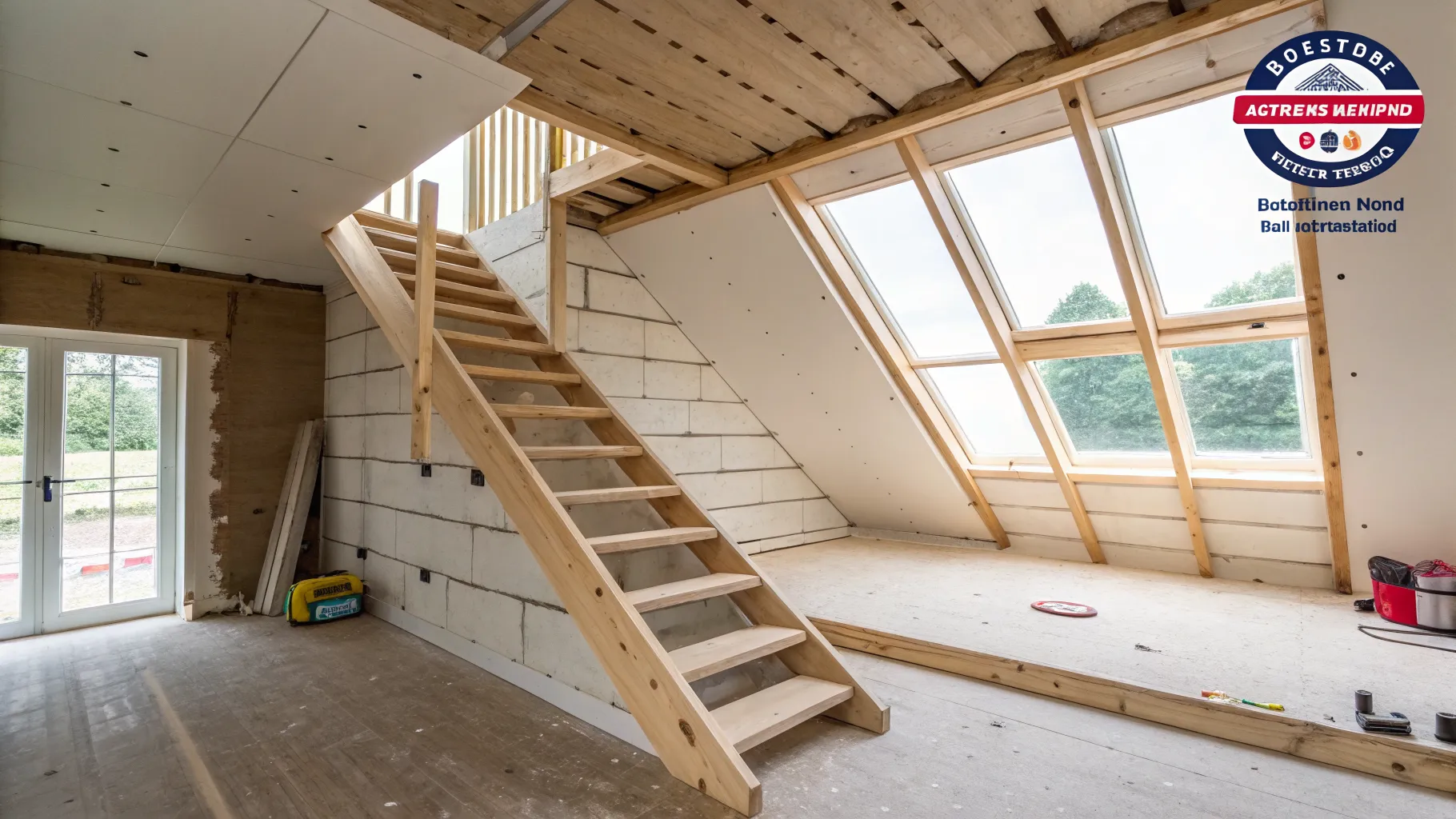
The staircase must be permanent and fixed. A loft ladder or pull-down stair does not comply for a habitable conversion, no matter how tight the space. This is non-negotiable, and it is where the floor plan below often has to give up a bedroom or chunk of landing.
The numbers from Approved Document K:
- Pitch: 42 degrees maximum for a domestic stair.
- Rise: between 150mm and 220mm per step, consistent throughout.
- Going (tread depth): between 220mm and 300mm, consistent throughout.
- The 2R + G rule: twice the rise plus the going should fall between 550mm and 700mm. This keeps the stair comfortable to climb.
- Handrail: 900mm to 1000mm measured vertically above the pitch line. One side is enough if the stair is under 1m wide; both sides if wider.
- Balustrade gaps: a 100mm sphere must not pass through any gap in the guarding, so children cannot slip through. This is the “100mm rule”.
There is no statutory minimum stair width in England and Wales, but around 600mm is the practical floor for a loft. Comfortable use is the test the inspector applies.
The headroom exception that makes lofts work
Standard headroom over a stair is 2.0m of clear height above the pitch line. Under a sloping roof you often cannot achieve that. Approved Document K builds in a loft-specific relaxation: where 2.0m is impossible, you may drop to a minimum of 1.9m at the centre of the stair width, tapering to a minimum of 1.8m at the lower edge. Those exact figures, 1.9m centre and 1.8m edge, are what Building Control will check, and they are the difference between a workable conversion and an impossible one.
Space-saver and alternating-tread stairs
Alternating-tread or paddle stairs are permitted only where there is genuinely no room for a conventional stair, only for access to a single habitable room (plus an en-suite or bathroom off it), and only with handrails on both sides and slip-resistant treads. Building Control has to sign them off. They are a last resort, not a default way to save floor space.
Fire safety: Approved Document B, Volume 1
This is where the two-storey versus three-storey distinction does the most work.
Fire doors and the self-closer myth
Doors opening from habitable rooms onto the stairway or escape route should be fire-resisting. The technical minimum in Approved Document B for a single-family dwellinghouse is FD20, a 20-minute fire door. In practice the product that is widely stocked and that inspectors expect to see is FD30, the 30-minute door, so that is what most builders fit. The honest framing: FD30 is the standard fitted on site, while the Approved Document minimum is 20 minutes. Bathrooms and WCs without a fuel-burning appliance generally do not need a fire door.
Now the point that half the web gets wrong. Self-closing devices are not required on fire doors within a single private house loft conversion. Approved Document B does not mandate them for houses, and the older rule that did was dropped back in 2007. Many commercial pages still state closers are compulsory; they are confusing houses with flats and HMOs, which are a different regime entirely. What your fire doors do need is intumescent strips and cold-smoke seals fitted around the frame.
The protected stair at three storeys
When the conversion creates a third storey, you must provide a protected stair: a continuous fire-resisting enclosure running from the new loft all the way down to a final exit door to outside. The walls and ceiling enclosing that stair have to give 30 minutes’ fire resistance, typically achieved with fire-rated plasterboard, taped and sealed. Existing floors and structure along the route may need upgrading to the same 30-minute standard. The idea is a clean, smoke-free corridor of escape from top to bottom.
Escape windows, and what they cannot do
For a two-storey conversion only, an escape (egress) window can be an acceptable alternative to a fully protected stair in the new rooms. The Approved Document B window specification:
- Clear openable area at least 0.33 m².
- No dimension less than 450mm, so at least 450mm high and 450mm wide.
- Bottom of the openable area generally 800mm to 1100mm above the floor, relaxed to 600mm to 1100mm for roof windows.
- It must open without a key or tool.
The correction that trips people up: an escape window cannot replace a protected stair once the loft is a third storey. At three storeys the protected stair is mandatory, and any window is supplementary, not a substitute. Two-storey, window can stand in; three-storey, it cannot.
Smoke alarms
Mains-powered, interlinked smoke alarms on every storey, sited in the stairway or circulation space at each level. A heat alarm in the kitchen is good practice and often required.
The open-plan ground floor problem
Here is the expensive surprise. If your protected stair discharges into an open-plan living and kitchen area on the ground floor, the simple protected route breaks: the bottom of your escape stair empties straight into the room most likely to be on fire. Building Control will require one of three fixes:
- Enclose the stair, or the kitchen, with fire-resisting construction and a door, restoring a separated route to the exit.
- Fit a domestic sprinkler or water-mist system to the open-plan area, designed to BS 9251.
- Provide an alternative independent escape route from the top floor to its own final exit.
Sprinklers are not routinely required, but they become the answer where the layout simply cannot be compartmentalised, for example a knocked-through ground floor you are not willing to wall back up. A retrofit sprinkler or mist system is a genuine budget shock; people are caught out by it because nothing earlier in the project hints it is coming. If your ground floor is open-plan and your loft will be the third storey, raise this with your designer and Building Control before you finalise anything. The Planning Portal’s loft conversion fire safety guidance is the best plain-English overview, and the detail sits in the GOV.UK Approved Document B Volume 1 PDF.
The new loft floor and its supporting joists and beams must also achieve at least 30 minutes’ fire resistance in their own right.
Insulation and thermal performance: Approved Document L
The roof of a habitable loft conversion needs to hit a U-value of 0.18 W/m²K. That is the target for a pitched roof insulated at rafter level, which is the construction a conversion uses. (You will see tighter figures quoted, around 0.15 to 0.16 W/m²K, for insulation at ceiling level, which is the cold-loft case, not a habitable conversion.)
A habitable conversion uses a “warm roof”: insulation moves up to rafter level so the loft sits at room temperature, rather than insulating the floor and leaving the roof space cold. Roughly, hitting 0.18 W/m²K means one of:
- About 270mm of mineral or fibre wool.
- About 175mm of rigid board.
- About 125mm of high-performance spray foam.
With PIR rigid boards such as Celotex or Kingspan, roughly 120mm to 150mm fitted between and under the rafters usually gets you there. The trade-off matters: PIR is much thinner than wool for the same performance, which saves the precious headroom a loft never has to spare. Insulating to 0.18 W/m²K eats ceiling height, and on a tight loft every 50mm counts, so the thinner material often wins despite the higher cost per board.
One detail that prevents rot: keep a 50mm clear air gap between the top of the insulation and the underside of the roof deck or felt, running from eaves to ridge, so moisture can vent. You can run a closed system without that gap only where a breathable membrane permits it.
The other regulations, briefly
Part F (ventilation): each habitable room needs an openable area of at least 1/20th (5%) of the room’s floor area, plus background or trickle ventilation, typically 5000mm² of free area per habitable room. There is no separate legal rule that natural light must equal 20% of floor area; ignore pages that claim one.
Part E (sound): for conversions, separating floors and walls between dwellings need 43dB airborne sound resistance (45dB for new build), internal airborne a minimum of 40dB, and impact sound no more than 64dB (62dB new build). This matters most for terraced and semi-detached party elements and where the loft is a bedroom or office.
Part P (electrical): all new wiring must comply with Part P and BS 7671, currently the 18th Edition Wiring Regulations. You may need a consumer-unit upgrade, and the work must be certified.
Party Wall etc. Act 1996: separate from Building Regulations, but commonly triggered. If you cut into or alter a shared party wall, for instance bearing new steels into it or raising it, you must serve notice on the neighbour, usually around two months before work starts. Terraces and semis nearly always need this.
Getting it approved and signed off
There are two routes. A Full Plans application has your drawings approved before work begins, which is the sensible choice for fire-critical loft work. A Building Notice lets you start without pre-approval and is riskier here, because if the inspector disagrees with a fire or stair detail after it is built, you are unpicking finished work. Either local-authority Building Control or a registered Building Control Approver (a private inspector) can sign off; since the Building Safety Act, both operate alongside each other.
A typical sequence: submit Full Plans with structural calculations, wait roughly four to five weeks for approval, then staged interim inspections at the structure, fire, insulation and ventilation stages, then a final inspection, then your completion certificate.
That completion certificate is the document that matters most after the dust settles. Without it you will hit problems selling the house and arranging insurance, because a buyer’s solicitor and lender will ask for it. Getting Building Control involved from the start, rather than retrofitting compliance, is far cheaper than fixing it later; the same logic applies to any extension, as we cover in Building Control sign-off for an extension. If you are weighing the loft against going outward instead, the single-storey extension cost guide sets out the comparison.
Frequently asked questions
Do I need building regulations for a loft conversion if I do not need planning permission? Yes, always. Planning permission and Building Regulations are separate. Most loft conversions are permitted development and skip planning, but every habitable conversion still has to meet the regulations on structure, fire, stairs, insulation and ventilation, and be signed off with a completion certificate.
Do all bedroom doors in the house need to be fire doors after a loft conversion? The doors that need to be fire-resisting are those opening from habitable rooms onto the protected stairway or escape route, because that route has to stay smoke-free from the loft down to the front door. Bathrooms and WCs without a fuel-burning appliance generally do not need one. The exact scope depends on your layout, so confirm it with Building Control.
Do loft conversion fire doors need self-closers? No, not in a single private house. Approved Document B does not require self-closing devices on fire doors within a house loft conversion. Self-closers are required in flats and HMOs, which is a different regime; many web pages wrongly apply that rule to houses. Your fire doors do need intumescent strips and cold-smoke seals.
What is the minimum ceiling height for a loft conversion? There is no single legal minimum height for the room itself, though around 2.2m of usable headroom is the practical rule for a comfortable space. The legal figures that do exist apply to the stair: 2.0m standard headroom, relaxed to 1.9m at the centre and 1.8m at the edge under a sloping roof.
Can I use a ladder or a space-saver staircase? A ladder, no: the stair must be permanent and fixed. A space-saver or alternating-tread stair is allowed only where there is genuinely no room for a conventional stair, only for access to a single habitable room plus its en-suite, and only with handrails both sides and slip-resistant treads, signed off by Building Control.
My stairs come down into an open-plan kitchen and diner. What happens? The simple protected escape route breaks, because the stair empties into the room most likely to be on fire. Building Control will ask you to either enclose the stair or kitchen with fire-resisting construction and a door, fit a domestic sprinkler or mist system to BS 9251, or provide an independent alternative escape route from the top floor. The sprinkler fix is the one that catches budgets out.
Can an escape window replace a proper staircase or protected route? Only in a two-storey conversion, where an escape window meeting the Approved Document B spec can stand in for a fully protected stair. Once the loft becomes a third storey, a protected stair is mandatory and the window can only be supplementary. It can never replace the stair at three storeys.
How thick does loft insulation need to be, and will it lower my ceiling? To reach the 0.18 W/m²K target you need roughly 270mm of wool, about 175mm of rigid board, or around 120mm to 150mm of PIR between and under the rafters. Yes, it lowers the ceiling, which is why thinner PIR is popular on tight lofts despite the higher cost.
What happens if I buy or sell a house with an uncertified loft conversion? Without a completion certificate you can expect questions from buyers, solicitors and lenders. The usual remedies are indemnity insurance, or applying for a regularisation certificate to have the existing work inspected and certified retrospectively. It is far simpler to get sign-off at the time than to chase it years later.
Do I need a party wall agreement? If your work cuts into or alters a shared party wall, which is common on terraces and semis when steels bear into the wall or it is raised, you must serve notice under the Party Wall etc. Act 1996, usually around two months before starting. This is separate from Building Regulations and from planning.
More from Sareth Build Journal
Keep reading
Do You Need Planning Permission for an Extension? Permitted Development Limits Explained
Do I need planning permission for an extension? Often no, thanks to permitted development. Here are the exact UK size limits, rules and exceptions.
Read entry
How to Serve a Party Wall Notice: Step-by-Step Template and Timeline
How to serve a party wall notice in the UK: the steps, a free template, exact notice periods and the timeline from service to award.
Read entry
Planning Permission Refused: Your Options for Appeal and Resubmission
Planning permission refused? What to do next: read the refusal reasons, fix and resubmit a revised scheme, or appeal to the Planning Inspectorate.
Read entry